
The Ultimate Guide to Window Hardware: Identifying and Replacing Key Parts
Updated: Apr 6
Last Tuesday, a homeowner in Leeds discovered that a single worn friction stay, measuring just 300mm, was responsible for a 15% spike in his monthly heating costs. You've likely felt that same sharp draught or struggled with a handle that refuses to lock, leaving your home vulnerable and cold. Faulty window hardware isn't just a minor annoyance; it's a breach in your home's primary line of defence. When a window fails to seal, your security and your bank balance both take a hit.
We understand that the prospect of measuring technical components feels daunting, especially when a 2mm error means the replacement part simply won't fit. You deserve a home that's draught-free and fully secure without the stress of "trial and error" ordering. This guide provides the precision you need to identify, measure, and replace your components correctly the first time. We'll break down the specific dimensions of hinges, espagnolette locks, and handles to ensure your DIY repair delivers a professional-grade result that lasts for years.
Key Takeaways
Identify the "Espag" and other critical components that form the backbone of your home’s security and thermal seal.
Diagnose common mechanical failures like draughts and "dropped sashes" to understand exactly why your windows are sticking.
Master the "Golden Rule" of measurement to ensure you order the correct replacement window hardware for a seamless fit.
Learn why selecting salt spray tested, high-quality components is essential for long-term durability in the British climate.
Restore your home’s security with our expert guide to identifying and replacing worn parts with professional precision.
Table of Contents
What is Window Hardware and Why Does It Matter?
Window hardware is the collective term for every mechanical component that allows your windows to open, close, lock, and seal. It is the engine of the window system. While the glass and frame define the look of your home, the hardware provides the utility. This includes hinges, handles, locks, and pulleys that ensure smooth, reliable operation. Without these precision parts, a window is simply a static piece of glass that offers no ventilation or security.
We distinguish between aesthetic and functional hardware to help homeowners prioritise their maintenance. Handles are the aesthetic touchpoints you interact with every day. However, the internal mechanics like friction stays, espagnolette bolts, and shoot-bolts do the heavy lifting. Your home's safety and comfort depend on these parts working in total synchronisation. When one component fails, the entire unit's integrity is at risk. Reliable window hardware ensures your home remains a sanctuary against both intruders and the elements.
The Link Between Hardware and Energy Bills
Draughts often start with worn friction stays rather than the glass itself. When these hinges lose their calibration, the window sash fails to pull tight against the frame. This creates gaps as small as 2mm that allow expensive heat to escape and cold air to whistle in. Replacing a £15 hinge set can stop these drafts instantly and save you up to £145 on annual heating costs. Functional gaskets and window hardware maintain the airtight seal your home needs to stay warm during a harsh UK winter.
Security Standards in the UK
Robust hardware is your first line of defence against unauthorised access. UK insurance providers typically require locks that meet PAS 24 standards to validate your home cover. Modern homes rely on multipoint locking systems that secure the window sash at three or more points along the frame. This distributed pressure prevents intruders from using a crowbar to jemmy the window open. According to the Office for National Statistics, 76% of UK domestic burglaries involve entry through a door or window. High-quality hardware stops these attempts before they begin.
The Anatomy of a Window: Identifying Key Components
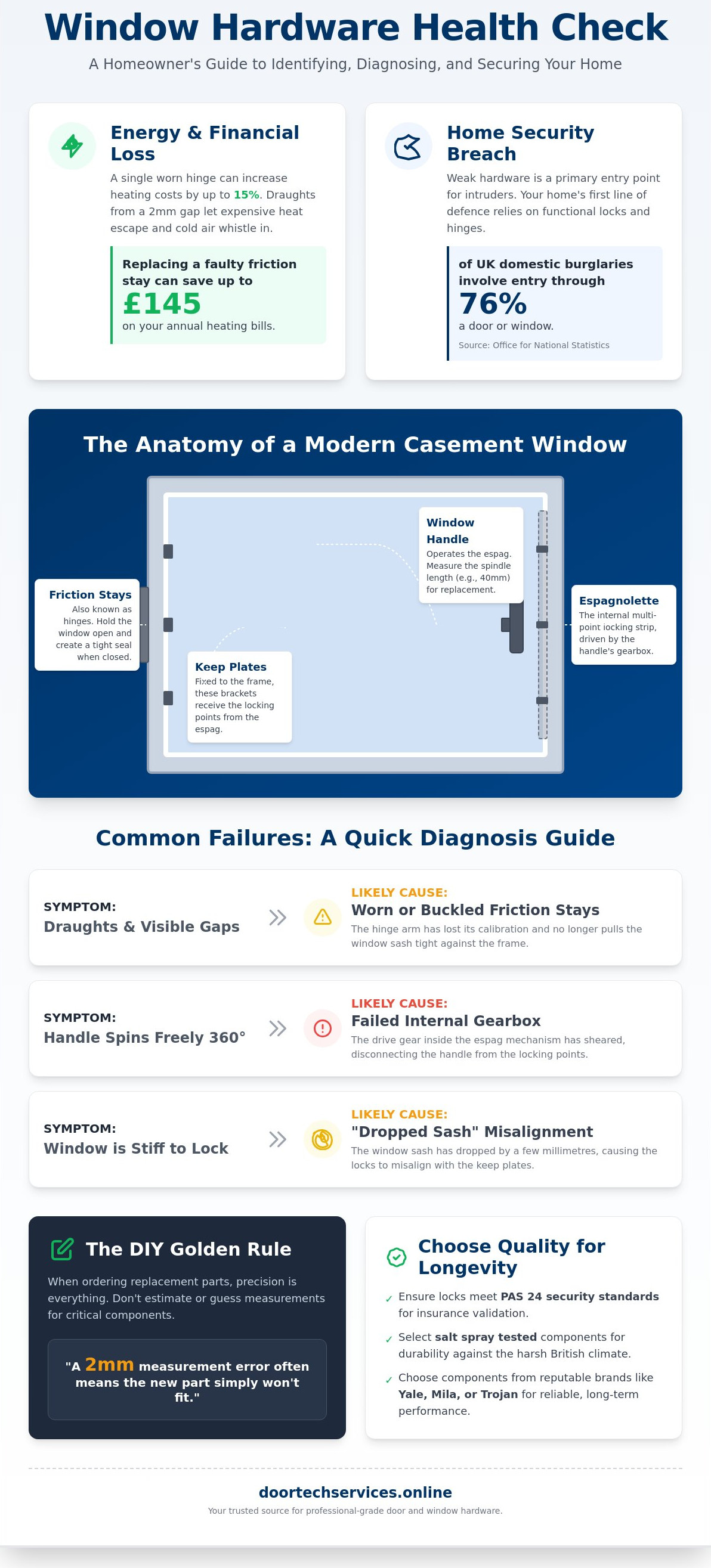
Understanding your window hardware is the first step toward a secure home. A standard UK casement window relies on a complex internal system to function correctly. The Espagnolette, often called an "Espag," sits hidden within the window sash. It acts as the heartbeat of your security. This long metal strip features locking "mushrooms" or bolts that move when you turn the handle. If your handle rotates freely without engaging the locks, the internal gearbox has likely failed. Identifying these parts correctly ensures you order the right replacements and restore your home's security without delay.
Window Handles: More Than Just a Grip
Identify your handle type before attempting a repair. Inline handles are straight and operate in either direction. Cranked handles are offset to the left or right to provide better clearance for your hand. Most modern UK windows use Espag handles with a 7mm square metal spindle. Older frames might use Cockspur handles, which latch over the frame rather than driving an internal lock. Spindle length is the most vital measurement. Most standard units require a 40mm spindle, but you must measure from the base of the handle to the tip to ensure a precise fit.
Friction Stays and Hinges
Hinges in the UK are commonly known as friction stays. They are called "stays" because they use internal sliders to hold the window open in a specific position against wind pressure. You'll find three main types in domestic properties. Standard hinges usually open to a 60-degree angle. Egress hinges open to a full 90 degrees to satisfy fire escape regulations. Easy-clean hinges allow the sash to slide across the frame, which lets you clean the external glass from inside the room. If you feel a draft or see a visible gap on the hinge side, the metal arm has likely buckled or the plastic end cap has perished.
Locks and Keep Plates
The keep plate is the metal bracket fixed to the window frame. It houses the bolts or cams when the window is locked. Modern window hardware relies on multipoint locks to distribute pressure evenly across the frame. This system ensures that one turn of the handle secures the window at three or more separate points. You will often see brand names like Yale, Mila, or Trojan stamped onto the metalwork. If your window feels stiff to lock, the sash has likely dropped by as little as 2mm. You can request a professional alignment check to prevent the locking mechanism from snapping under the extra tension.
Common Window Hardware Failures: Draughts and Jams
Windows often fail because of mechanical fatigue rather than glass damage. If your window feels heavy or resists movement, the friction stays are likely clogged with grit or have lost their factory lubrication. Forcing a stubborn handle is a mistake. This pressure often snaps the internal gearbox, a component that typically costs between £20 and £55 to replace. If the handle spins 360 degrees without moving the locking points, the drive gear has sheared. You'll need a replacement espagnolette rod to restore security.
The "dropped sash" is another frequent issue. This happens when the glass unit isn't packed correctly or the hinges wear down over time. You'll notice the top corner of the opening sash hitting the frame or a visible gap at the top. This misalignment prevents a weather-tight seal and puts immense strain on the window hardware. Ignoring a dropped sash can lead to a total lock failure, potentially leaving your home vulnerable or trapping the window in an open position during a storm.
Solving the 'Stiff Window' Problem
Test your hinges by clearing the track of debris and applying a silicone-based lubricant. If the resistance continues, the friction stay's brass slider has likely worn thin. This metal-on-metal friction creates that "stiff" sensation. Replace these hinges immediately to avoid breaking the internal locking system. A pair of standard UK friction hinges costs roughly £15 to £25. It's a cost-effective preventative repair that saves you from a £150 emergency call-out fee later.
Identifying Gasket and Seal Failure
Draughts usually stem from two sources: failed hinges or perished gaskets. Check your seals for "shrinkage" at the corners, which is common in properties over 10 years old. Gaskets can lose 5% of their elasticity every five years. Replacing old rubber with high-quality window hardware seals restores comfort instantly.
Universal Bubble Gaskets: These push into a groove and provide a soft, air-tight cushion. They're compatible with 90% of uPVC profiles.
Wedge Gaskets: These are pushed between the glass and the frame to create compression. They come in various thicknesses, usually colour-coded from 2mm to 5mm.
Schlegel Q-Lon: This is the premium choice for draught-proofing. It features a foam core that doesn't shrink, offering superior thermal performance even in temperatures as low as -20°C.
A 3mm gap caused by a flattened seal can increase your annual heating costs by approximately £45 per room during a typical UK winter. We recommend a full perimeter check every autumn. If you can slide a piece of paper through the closed window, your seal has failed. Act quickly to secure your home and reduce energy waste.
The DIY Identification Guide: How to Measure Replacement Parts
Precision is your best friend. Measure twice, order once. This is the golden rule for replacing window hardware. You need a reliable tape measure, a screwdriver, and a digital calliper for the most accurate results. Accuracy prevents delays and ensures your home remains secure. Always identify the 'handing' of your parts before clicking buy. Stand inside your home and look at the window. If the hinge or handle sits on the left, you need a left-handed part. If it's on the right, it's right-handed. Getting this wrong means the part simply won't function with your frame's mechanics.
Measuring Friction Stays (Hinges)
Open the window fully to measure the total length of the metal hinge track. Standard UK sizes usually range from 200mm to 600mm. You must determine the stack height accurately. This is the total thickness of the hinge when it's closed. Most uPVC windows use either a 13mm or a 17mm stack height. A 4mm discrepancy will prevent the window from closing flush against the frame. Finally, verify the track width. Standard uPVC tracks are 18mm wide, though some slimline aluminium frames use 15mm tracks.
Measuring Window Handles and Spindles
For espag handles, the spindle length is the vital statistic. Measure the square metal bar protruding from the back of the handle base. Common lengths include 15mm, 30mm, and 40mm. Most modern handles use a standard 43mm screw hole centre, often called the PZ measurement. If you're dealing with older cockspur handles, you must measure the 'step height.' This is the distance from the base of the handle to the underside of the locking nose. These typically range from 9mm to 21mm in 3mm increments.
Identifying Your Gasket Profile
Worn seals cause 30% of heat loss in older homes. Remove a 50mm sample of your existing gasket to inspect the cross-section profile. Compare your sample against the three industry standards: Bubble, E-Gasket, and Wedge seals. If your window frames are more than 12 years old, finding an exact match is often impossible. Universal gaskets are the solution here. These versatile seals use a fluted design to fit 95% of uPVC profiles, providing an immediate airtight seal without the need for specific brand matching. High-quality window hardware requires a perfect seal to function at peak efficiency.
Avoid the frustration of incorrect parts and book a professional window hardware inspection today.
Choosing High-Quality Window Hardware for Long-Term Performance
Don't compromise on your home's security to save a few pennies. Cheap, unbranded window hardware often fails within 12 to 18 months of installation. These budget components typically use brittle zinc alloys that snap under the constant pressure of modern double glazing. In the UK, weather is your biggest enemy. Coastal properties within 5 miles of the sea require components that are 'Salt Spray Tested' to BS EN 1670 standards. Look for Grade 4 or 5 ratings to ensure your hinges won't seize after a single damp winter.
Why Quality Materials Save Money
Material choice dictates your long-term maintenance costs. Zinc alloy handles might look shiny on the shelf, but they often pit and peel within two years. High-grade 304 or 316 stainless steel components offer the structural integrity needed for heavy-duty use. A premium friction stay should easily handle 20,000 cycles without sagging. Spending an extra £15 on trade-quality parts today prevents a £150 emergency repair bill next season. Quality hardware manages the physical behaviour of the window, ensuring it seals tightly every time you close it.
The Door-Tech Services Advantage
We provide access to professional-grade parts that high-street DIY stores simply don't stock. Our expertise covers UK-specific window profiles and legacy hardware found in older homes. We understand the technical nuances of stack heights and spindle lengths. You get the same gear used by professional installers, backed by our commitment to durability and home safety. Browse our full range of Window Hardware and find your perfect match today.
Final Pre-Purchase Checklist:
Measure the backset and spindle length of your handle precisely.
Confirm if your friction stays require a 13mm or 17mm stack height.
Verify the direction of opening for handed components like espagnolette gear.
Check that screw hole centres align with your existing frame holes to avoid drilling new ones.
Ensure the component is rated for the weight of your specific glass unit.
Restore Your Home’s Performance and Security
Don't let a faulty latch or a worn seal compromise your home's warmth. Identifying the correct window hardware is the first step toward a draught-free property. Precise measurements ensure a seamless fit, while high-quality components prevent the recurring frustration of jams and leaks. Replacing a perished gasket or a broken handle isn't just a quick fix; it's a vital upgrade for your property's efficiency.
Door Tech Services has operated as a specialist UK-based supplier since 2007, we provide an expert range of Schlegel Q-Lon and Universal Gaskets to ensure your repairs stand the test of time. We focus on technical precision so you don't have to worry about repeat failures or poor weather resistance. Our components are selected for their durability and ease of installation.
Stop the cold from entering your home today. Shop our professional-grade Window Hardware collection to find the exact parts you need for a perfect repair. You've got the knowledge to identify the problem, and we've got the trade-standard tools to help you finish the job properly.
Frequently Asked Questions
How do I know if I need to replace my window hinges or just lubricate them?
You must replace your hinges if the window sash doesn't close flush or if you see visible metal fatigue like cracks or severe rust. Lubrication with a silicone-based spray often fixes stiff movement, but it won't correct a dropped window or a 3mm gap caused by worn friction stays. Inspect the brass sliders; if they're snapped or heavily worn, the hardware is compromised. Replace them immediately to restore your home's thermal efficiency.
Can I replace my window handles with a different style or colour?
You can upgrade your handles to a different style or finish as long as the spindle length matches your current setup. Most modern Espag handles use a standard 43mm fixing centre, allowing you to switch from white plastic to brushed chrome or gold finishes easily. Ensure the spindle reaches the internal gearbox; common lengths include 15mm, 30mm, and 40mm. This simple window hardware update improves both aesthetics and grip.
What is the difference between a left-hand and right-hand window handle?
The difference lies in the direction the lever curves and points when in the closed position. A right-hand handle points right and moves clockwise to open, while a left-hand handle points left and moves anti-clockwise. Cockspur handles are specifically handed, so check your existing set before ordering. Installing the wrong hand can result in a 5mm misalignment with the striker plate, preventing a secure lock and risking your home's security.
Why is there a gap at the top of my window when it is closed?
A gap at the top usually indicates that your friction stay hinges have failed or the pull-in block is worn down. Over 82% of draught issues in UK homes stem from hinges that no longer pull the sash tight against the frame seal. If the gap exceeds 2mm, your energy bills could rise by 12% due to heat loss. Inspect the hinge track for debris or replace the pair to ensure a weatherproof seal.
Are all PVCu window handles the same size and fit?
No, PVCu handles vary by type, though Espag handles share a universal 43mm screw hole spacing. You must distinguish between Espag, Cockspur, and Tilt and Turn varieties to ensure compatibility. Tilt and Turn handles often require a thicker 7mm spindle to manage the weight of the glass. Always measure the spindle length accurately; a difference of just 5mm can prevent the window hardware from engaging the locking mechanism properly.
How do I measure the 'stack height' of my window hinges?
Measure the stack height by closing the hinge and measuring the total thickness of the metal arms, including the plastic slider. UK windows typically use either a 13mm or 17mm stack height. Using a 17mm hinge on a 13mm frame will prevent the window from closing, while the reverse creates a loose, draughty fit. Use a digital calliper for 100% accuracy to ensure your replacement parts provide a seamless, heavy-duty fix.
What happens if I use the wrong type of window gasket?
Using the wrong gasket leads to immediate seal failure, resulting in water ingress and a 15% decrease in acoustic insulation. If the rubber is too thick, you'll put excessive strain on the hinges and handles, potentially snapping the internal gearbox. If it's too thin, you'll feel cold air rushing through. Match your profile exactly, whether it's an E-gasket or a bubble seal, to maintain a certified, airtight finish.
Is it possible to upgrade my window security with better hardware?
You can significantly boost security by installing PAS 24 certified locks and heavy-duty sash jammers. Adding sash jammers provides an extra layer of resistance against forced entry, costing as little as £10 per window. Upgrading to key-locking handles and high-security friction stays with integrated dog bolts prevents the sash from being jemmied open. These precision-engineered components turn a standard window into a robust barrier, providing immediate peace of mind for your family.

Comments